


Tools in Service of Architecture:
AI at Davey Studio Architects
Every practice right now is asking the same question about artificial intelligence: not whether to use it, but how — and how far to go. At DSA, we’ve been working through that question across the studio — from visualisation to how we run the practice itself. Here’s where we’ve landed, and why judgment still belongs to the architect
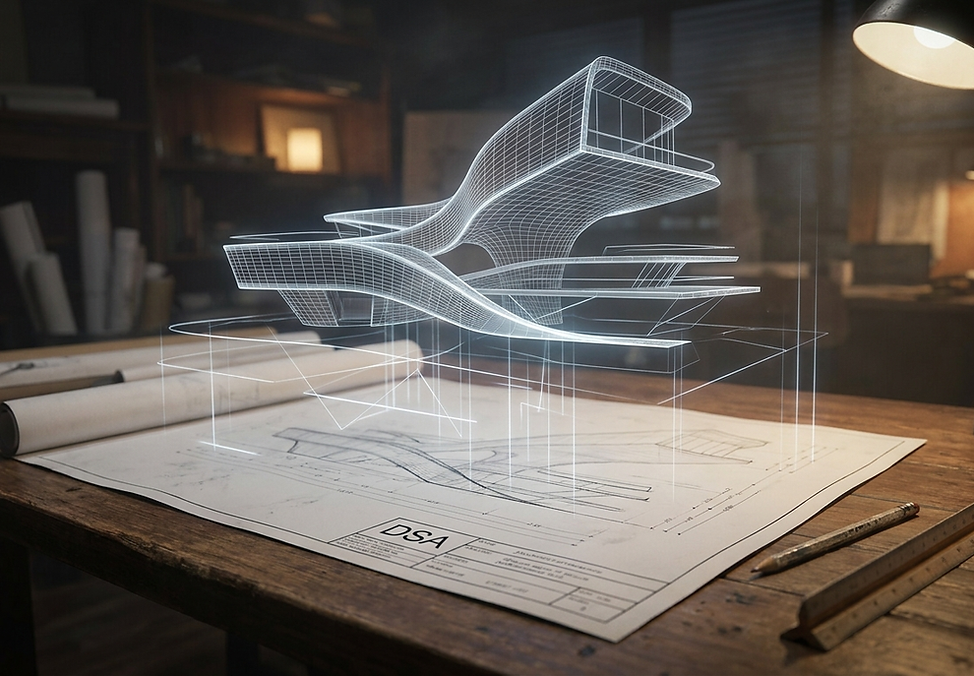
Architecture has reached an inflection point with artificial intelligence. The question in most studios is no longer whether to use it, but how — and how far to go. Yet for all the noise, real adoption is still surprisingly shallow.
Bluebeam's 2026 AEC Technology Outlook, a global survey of more than 1,000 architecture, engineering and construction professionals, found that only 27% of firms use AI in their operations at all.
The latest Chaos and Architizer survey of nearly 800 architects and designers found that while most have experimented with AI tools, only 20% have fully embraced them in their workflow — and a BST Global survey reported that just 20% of AEC firms feel highly prepared for implementation. The most common use, by some distance, remains generating concept images in the earliest stages of design.
At Davey Studio Architects, we've chosen to go further — deliberately, and with our eyes open.
Beyond the Pretty Picture
Like much of the profession, we use AI in the early, exploratory stages of design, where rapid iteration sharpens thinking and helps us test ideas quickly. We also use the latest visualisation and cinematic tools to communicate our schemes — to bring a masterplan, a streetscape or a sense of place to life for clients, communities and stakeholders long before the first home is occupied.
But the part we're proudest of is less visible. We've integrated AI into the connective tissue of the practice itself: the research, correspondence, scheduling, document preparation and cross-referencing that quietly consume a studio's time. Automating the routine doesn't replace the work that matters — it protects it. Every hour we don't spend on administration is an hour returned to design, to detail, and to the people we build for.
That whole-practice integration is where we believe we're some way ahead of the field. Most firms are still using AI as a faster image generator; we're using it as infrastructure.
The Architect Stays in Charge
The firms integrating AI most deeply are also the ones thinking hardest about its limits — and so are we. The technology is fast, but it is not infallible. It can be confidently wrong. It has no stake in the outcome, no professional duty, and no judgment of its own.
So we treat every AI output as a draft, never a decision. Geometry is checked against our models. Facts are verified against primary sources. Design intent, technical compliance and the responsibility we carry to our clients and to the public remain — entirely and always — human. AI accelerates our work; it does not author it.
"We see AI as a powerful set of tools in the service of architecture — not a substitute for it. Used well, it gives us back time and clarity, so the craft, care and judgment that define good buildings get more of our attention, not less."
— Greg Davey, Director, Davey Studio Architects
Why It Matters for Our Clients
For the people we work with, this translates into something simple: better-considered design, communicated more clearly, delivered by a studio that moves quickly without cutting corners. It means concepts you can see and understand earlier. It means a practice whose time is spent where it counts.
Technology in our field will keep changing fast. Our commitment won't: to adopt what genuinely improves the work, to be honest about what it can and can't do, and to keep architecture — the discipline of making good places for people — firmly at the centre of everything we do.
Davey Studio Architects is a Dublin-based practice specialising in large-scale residential and urban design.
Sources: Bluebeam, Building the Future: AEC Technology Outlook 2026 (survey of 1,000+ AEC professionals, October 2025); Chaos & Architizer, The State of AI in Architecture 2026 (survey of nearly 800 architects and designers); BST Global AI + Data Insights survey, via Engineering News-Record.